

Live-service games receive a constant stream of requests, ideas, and feedback. But deciding which features to build requires balancing internal factors players rarely see: game stability, operational costs, outcome uncertainty, seasonal timing, and competitive protection.
A player-facing backlog would give players a high-level view of feature categories a team is evaluating — without revealing sensitive plans or implying commitments. According to a 2024 Deloitte analysis of trust in digital gaming ecosystems1, structured and predictable transparency can be one of the strongest levers for improving player confidence.
What Is a Player-Facing Backlog?
A player-facing backlog would be a safe, simplified version of internal planning tools. It would present feature categories or problem spaces under review, supported by brief developer context, difficulty indicators, and optional voting. This follows the principle of “transparency by design,” described in Science and Engineering Ethics3, which argues that transparency must be purposeful and scoped.
Core Components of a Player-Facing Backlog
A well-designed player-facing backlog requires clarity, structure, and intentional limits. Each component below plays a specific role in balancing transparency with production safety.
|
Curated Feature List |
Only items that have passed an initial internal review appear. This ensures the backlog reflects realistic areas of exploration rather than every idea ever suggested. Curating the list prevents noise, reduces misunderstanding, and avoids surfacing items the team already knows are infeasible. |
|
Feature Categories |
Items are presented at the category level (e.g., “Matchmaking System Review,” “Hero Role UI Updates”), not individual mechanical proposals. Categorization protects sensitive design details while giving players insight into which areas the team is thinking about. |
|
Player Voting |
Voting allows players to express what they care about most. This creates a structured signal for interest without dictating actual development priority. Votes influence ranking but do not override internal planning. |
|
Real-Time Ranking |
Rankings change automatically based on vote activity. Real-time movement reinforces transparency, helps players engage with ongoing discussions, and shows emerging interest trends. It should always be paired with messaging that ranking ≠ production order. |
|
Difficulty Meter |
A simple color or icon-based difficulty estimate helps players understand the relative complexity of each category. This manages expectations and helps explain why some items move slowly even if heavily requested. Difficulty should remain intentionally approximate. |
|
Tags |
Tags such as Engineering, UI, Balance, Art, Economy, or Events help players understand which disciplines a feature touches. They also highlight cross-team involvement and give context for why some features take longer than others. |
|
Developer Notes |
Short, neutral notes provide factual context without revealing design specifics, timelines, or implementation details. Notes should always explain the “problem area,” not the “solution,” keeping the backlog safe from competitive exposure and misinterpretation. |
|
Status Labels |
Labels such as Concept Stage, Under Review, Feasibility Review, or Not Scheduled provide clarity about where an item sits in the evaluation pipeline. Status labels help prevent false assumptions about confirmed releases. |
|
Update Cadence |
Updates occur on a predictable monthly or seasonal schedule. Consistency prevents players from interpreting changes (or lack of changes) as hidden signals about internal development. A fixed cadence reinforces trust and prevents roadmap speculation. |
|
Feedback Channels |
Structured feedback prompts (e.g., “What problem are you trying to solve?”) keep comments focused and actionable. This reduces noise and ensures player insights contribute meaningfully to evaluation rather than devolving into open-ended debates. |
Concept Preview: Player-Facing Backlog in Overwatch
The mockup below illustrates how a Player-Facing Backlog could appear inside an Overwatch-style interface. It adapts the visual language of Blizzard’s Hero Statistics page — clean filters, clear sections, and a compact data table — to demonstrate how backlog transparency can feel natural inside a live-service UI. This concept highlights three core ideas behind an effective player-facing backlog:
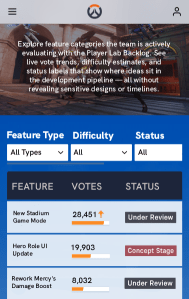
- Clarity without overexposure:
Feature categories, vote totals, difficulty levels, and status labels give players meaningful visibility without revealing internal details, timelines, or designs. - Familiar UX patterns:
By reusing Overwatch’s existing filter layout and content structure, players can quickly understand what they’re looking at. This reduces cognitive load and lowers the barrier to interacting with the backlog. - Actionable transparency:
Players can see which feature spaces are attracting interest, how items rise or fall in rankings, and where each idea sits in the evaluation process. This builds trust through predictable signals rather than promises.
While this mockup is intentionally lightweight, it demonstrates how a player-facing backlog can be presented safely and effectively: focused on categories, supported by structured metadata, and integrated into a UI players already understand. The goal isn’t to show every possible field, but to convey how the system could feel inside the game — informative, scannable, and aligned with Overwatch’s design language.
Player Lab Transparency FAQ (Concept)
The questions below illustrate how a player-facing backlog would communicate expectations clearly and consistently. This FAQ focuses on transparency, predictable communication, and the limits needed to keep the system safe, fair, and aligned with internal development processes.
Q: If something gets a ton of votes, does that mean it’s definitely coming?
- Not necessarily. Votes help show what players are most interested in, but they don’t decide what gets developed. The team still has to consider schedule, feasibility, and overall game health.
Q: How often would the Player Lab be updated?
- On a regular, predictable cadence — for example, once per month or once per season. Updates won’t happen in real time so players don’t mistake quick changes for development signals.
Q: Why can’t we see concept art, prototypes, or more detailed explanations?
- To avoid revealing unfinished designs or competitive information, the backlog only shows the broad problem areas being explored. Specific mechanics, art, numbers, or diagrams aren’t shared until they’re ready.
Q: If we leave feedback or vote a lot, can that move an item up the list?
- Feedback and voting help the team understand what players care about, but the actual status only changes when the development team updates their internal review. Visibility ≠ confirmation.
Risks and Safeguards
A player-facing backlog must be designed around specific risks. The table below summarizes each risk, why it occurs, and the safeguards that keep the system safe, predictable, and non-committal.
| Risk | Description | Safeguards |
|---|---|---|
|
Sensitive Ideas Exposed |
Details shared too early may reveal designs competitors can copy or anticipate. |
|
|
Vote-Driven Pressure |
Players may expect highly-voted items to be built first regardless of cost or fit. |
|
|
Misinterpretation of Status Labels |
Players may read “Under Review” as confirmation the feature is coming. |
|
|
Ranking Volatility |
Fast movement in rankings may be mistaken for development progress. |
|
|
Low-Quality or Repetitive Feedback |
Unstructured comment fields often fill with noise, spam, or hostility. |
|
|
Voting Misaligned With Production Reality |
Public voting may conflict with staffing, tech debt, or seasonal plans. |
|
|
Confusion About Development Schedules |
Frequent backlog updates may create unrealistic expectations about delivery speed. |
|
|
Items Too Vague |
If categories are overly abstract, players may not understand what’s being reviewed. |
|
Industry Approaches to Transparency
Below are examples of transparency approaches used by major live-service games. Each offers value, but each also has limitations. A Player-Facing Backlog addresses these gaps by focusing on evaluation instead of promises and structured transparency, as recommended in digital trust and transparency research.134
Fortnite — Public Bug Boards
How it works:
Epic has maintained public bug boards that list known issues and their status, giving players visibility into recognized problems and ongoing fixes.2
Shortcoming:
When boards go long stretches without visible movement, players often read that as inactivity or neglect, even when work continues behind the scenes.2
Bug boards also focus narrowly on bugs rather than broader systems or design evaluation.
How a Player-Facing Backlog solves it:
- Uses a predictable update cadence so the page never appears abandoned.1
- Shows feature and system evaluation, not only bug tracking.
- Frames items as “Under Review” rather than “promised fixes,” reducing misinterpretation and pressure.2
Warframe — Devstreams & Seasonal Roadmaps
How it works:
Digital Extremes shares plans through developer livestreams and seasonal roadmaps, giving players a direct line to the team and a rough outline of content direction.2
Shortcoming:
Roadmaps frequently shift, leading players to treat early discussion as commitment. When plans change, trust can erode.2
How a Player-Facing Backlog solves it:
- Removes dates and timelines entirely, avoiding roadmap-style promise pressure.12
- Uses status labels (“Concept Stage,” “Under Review”) to communicate uncertainty.3
- Lets devstreams provide flavor and detail while the backlog acts as the stable reference point for what is under review.4
Destiny 2 — Weekly Dev Blogs
How it works:
Bungie publishes weekly blogs explaining balance philosophy, system changes, and in-progress updates.
Shortcoming:
Blogs mainly cover work already underway. Players see reasoning but not the broader funnel of ideas being evaluated.
Software ecosystem research shows that users trust systems more when they understand how decisions are structured, not just the final results.4
How a Player-Facing Backlog solves it:
- Exposes early-stage evaluation in a safe, controlled manner.4
- Provides a persistent overview of which categories are under review.
- Reduces speculation about “why isn’t the team working on X?” by showing that some areas are being examined even before they reach blogs or patch notes.14
League of Legends — PBE Testing
How it works:
Riot’s Public Beta Environment lets players test upcoming content before release, offering hands-on transparency and direct gameplay feedback.
Shortcoming:
Even with disclaimers, players often assume anything on PBE is close to shipping. Early exposure of specific mechanics can create expectation risk and give competitors insight into design direction.3
How a Player-Facing Backlog solves it:
- Shares category-level information (for example, “Tank Survivability Review”) instead of revealing specific builds.3
- Communicates clearly that items are in review, not guaranteed for release.
- Shows that a problem space is being explored even before it becomes PBE-ready.1,3
Summary
A well-designed player-facing backlog would give live-service communities a clearer window into how teams evaluate ideas, without exposing sensitive plans or making accidental promises. Instead of functioning as a roadmap, it becomes a structured signal — a predictable, category-level view of what the team is exploring, why it matters, and where each idea sits in the review process. By combining selective visibility, consistent update cadence, status labels, and focused developer notes, the backlog reduces speculation, clarifies intent, and lowers the emotional volatility that often surrounds content expectations. At the same time, it avoids the pitfalls seen in other transparency models across the industry: over-interpretation of roadmaps, stagnation of public boards, misplaced expectations from beta testing, and limited visibility from traditional dev blogs. A player-facing backlog makes evaluation legible without revealing design secrets, giving players a grounded understanding of how decisions are shaped while allowing developers to maintain creative flexibility, production safety, and competitive protection. Done well, it strengthens trust not by promising more — but by showing how the team thinks, chooses, and learns over time.
Sources
- Deloitte. Game On, Securely: Data Privacy and the Gaming Industry (2024). Link
- Douglas Bogart. Transparency in the Game Industry. GameDeveloper.com (2016). Link
- Felzmann, H. et al. Towards Transparency by Design for Artificial Intelligence. Science & Engineering Ethics (2020). Link
- Zacarias, R. O. et al. Investigating Transparency in Software Ecosystems. ACM (2023). Link
 thetralfamadorian.com