
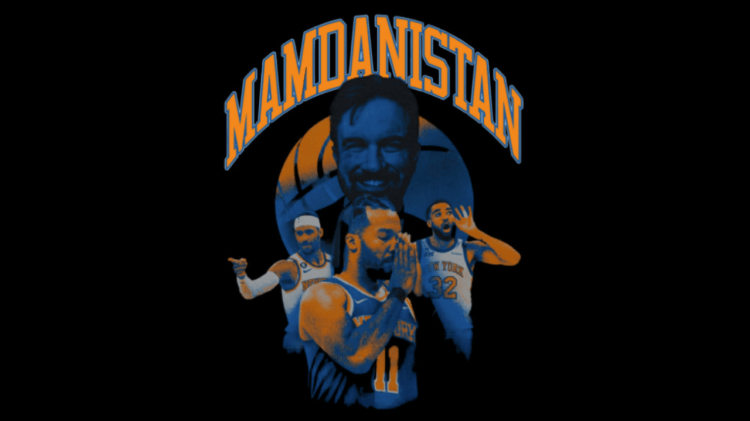
Sports fans understand something politicians often forget.
A city is not just roads, budgets, permits, and garbage pickup. It is a nervous system. And when a city strengthens its community, it feels alive and healthy.
The Knicks did not win the NBA Finals because Mayor Zohran Mamdani put on a suit and cast a socialist spell over Madison Square Garden. They won because they were excellent. They won because Jalen Brunson became a civic monument with a crossover. They won because good teams turn pressure into rhythm. But they also won because New York felt like a community again. That is where Mamdani mattered.
Vibe and Tempo in Basketball
Basketball is a vibe-sensitive sport because tempo is an integral part of how the game is played.
A shot becomes noise. Noise becomes pressure. Pressure becomes pace. Pace changes shot selection. Shot selection affects confidence. And confidence determines if the next shot goes in or not.
That is why “vibe” is not nothing. It is a slang term for a very real system: rhythm, crowd pressure, stress, confidence, attention, and timing. Vibe is tempo before it becomes visible.
Often players get irritated when someone shoots after the whistle, an unwritten rule not to do. The shot does not count, but everyone knows it still counts somewhere. A player sees the ball go in. A cold shooter gets a tiny visual memory of success. A tired team gets a moment to breathe. The scoreboard ignores it, but a player’s nerves don’t.
Home-court advantage also plays a part. Researchers found that NBA teams can experience changes in scoring rate depending on if they are home or away.
Hot-hand research, although messier, has found that some players also adjust behavior after makes and misses.
That does not prove magical momentum. It proves something more concrete.
Basketball players, fans, coaches, and arenas constantly respond to what just happened. Each possession becomes a referendum on the last one. Like many sports, basketball is not only played by bodies. It is played by “the room”.
The Knicks’ Finals run made that visible.
They did not cruise calmly into history. They survived. They trailed. They came back. They erased double-digit deficits in each of their four Finals wins. That kind of team does not merely execute. It keeps refusing “the room’s” worst interpretation of events.
Mamdani and Civic Tempo
How Policy Becomes Vibe When People Can Feel It
The easiest way to make this argument stupid is to say Mamdani won the Knicks a championship. The more appropriate version is that Mamdani helped make the championship feel public. That distinction matters. A city’s vibe is not produced by speeches alone. It is produced by repeated evidence that the city belongs to the people.
In his first months as mayor, Mamdani’s administration kept choosing policies and public rituals that did two things at once: reduce pressure on its citizens and increase shared public life in the form of community.
The childcare push is the clearest example.
Mamdani and Governor Kathy Hochul announced more than 2,000 free 2-K seats for two-year-old’s this fall, described as an early step toward universal child care for children from six weeks to five years old. That is not a symbolic vibe. That is a parent getting time, money, and sanity back. A city with good child care has a different tempo. Parents breathe differently. Families plan differently. People can participate in public life without feeling like every hour has been repossessed by survival.
Housing and transit point in the same direction.
Affordable housing says people should still be able to live in the place they are expected to love and work in. Fast and free buses show movement through the city should not be a daily punishment. These are not separate from sports culture. They are the conditions that decide who gets to remain part of the chorus.
Then there are potholes.
Mamdani’s administration filled 100,000 potholes in its first 100 days, the fastest pace in 11 years. This is not glamorous. That is why it matters. Every pothole is a small civic insult. It says the street does not care about your tire, your ankle, your stroller, your delivery route, or your commute. A city that fixes the street is saying something simple and powerful.
We know you are here and we respect you.
Trust is usually built in boring places.
Crosswalks. Bus stops. Child care centers. Heat warnings. Sidewalk screens. A government earns emotional permission by doing the unsexy work before it asks people to believe in the big story.
The Knicks became the big story.
During the Finals, Mamdani’s administration worked with LinkNYC and the NBA to stream games on public kiosks. For Game 5, 130 LinkNYC kiosks across the five boroughs showed the game live. Earlier that week, Game 4 became the first live sports broadcast on LinkNYC kiosks. That is the Mamdani-Knicks theory in one image. Strangers gathered around a sidewalk screen, watching the Knicks together, not because they could afford Madison Square Garden, but because the city turned infrastructure into a community. The Knicks stopped being limited to ticket prices, luxury suites, and bars with televisions angled slightly wrong. They became a public event.

That matters because sports are one of the few remaining civic rituals Americans still understand without needing a committee, app, or onboarding flow.
When a city streams the Finals on sidewalk kiosks, it is not only broadcasting basketball. It is broadcasting community. Mamdani turned the sidewalk into the Garden.
Trump and Broken Tempo
How One Visit Changed the Room
Game 3 should have been the Knicks’ cleanest emotional moment. They were up 2-0. The Finals were back at Madison Square Garden for the first time in more than two decades. New York was vibrating at a frequency usually reserved for subway drummers and tiny apartments with exposed brick.
Then Trump showed up.
Trump became the first sitting president to attend an NBA Finals game. He was booed at Madison Square Garden. His visit brought hard street closures, a strict no-bag policy, Secret Service-level screening, airport-style security procedures, and the cancellation of the watch party outside the arena. This is the opposite of community. It is not shared city life. It is everyone else rearranging themselves around one powerful person’s presence.
Trump is not the anti-thesis of New York because he is from somewhere else. He is from New York. That is part of the problem. He represents the version of the city that treats New York as a backdrop for power rather than a place shared by people.
Mamdani’s version of the city said, “The city belongs to everyone.”
Trump’s visit said, “The city belongs to me.”
Did Trump personally cause the Knicks to lose Game 3?
No. Causation is not a loose basketball rolling under the scorer’s table. You do not get to pick it up and throw it at whoever you dislike. But did Trump disrupt the conditions around the game?
Yes.
The public gathering changed. The security posture changed. The emotional weight changed. The night became less about New York coming together and more about federal presence, access control, and political spectacle.
The Knicks lost 115-111.
It was their only loss of the Finals.
That does not prove the theory. It gives the theory a box score, which is more than most sports beliefs ever get. The point is not that Trump beat the Knicks. The point is that he made New York feel less like the community-focused melting pot that New Yorkers take pride in. In basketball, that can be enough.
A game this sensitive to pace does not need a grand curse. It only needs a slight interruption. A slower entry into the game. A watch party canceled. A crowd made more guarded than joyful. A city forced to move around power instead of through each other.
Basketball punishes that kind of stiffness.
The Knicks won the title because Jalen Brunson was brilliant, because the team defended, because San Antonio repeatedly let leads evaporate, and because every championship contains at least one moment where logic slips on confetti.
But the Knicks also won inside a city that had been practicing togetherness.
Mamdani did not make the Knicks champions. He helped make the championship public. Trump did not personally defeat them in Game 3. He walked into the room and made the public feel allowed instead of invited.
Simply, Vibe Is Infrastructure
Vibe sounds unserious because the word has been abused by people describing apartments, coffee shops, and performative men with mustaches.
But civic vibe is not decoration. It is community given a heart beat.
A city has a better vibe when parents can afford child care. It has a better vibe when potholes are filled before residents give up on reporting them. It has a better vibe when buses move, housing remains possible, sidewalks become watch parties, and joy is not treated as a premium product.
For one game, Trump broke the vibe. The Knicks recovered because that is what this team did all postseason. They fell behind, absorbed the panic, and found the rhythm again.
That is the most New York ending possible.
Not perfection. Recovery.
Assimilation Question
If a city’s vibe is community made visible, what would your city have to fix, fund, or celebrate before people started believing in it again?

